


Denmark isn’t a country most Eurovision fans and followers have had much faith in during the past decade — and honestly, fair enough. Since Emmelie de Forest won the Eurovision Song Contest in 2013 with Only Teardrops, the country has delivered a string of results that have left Danes and ESC fans alike dejected.
Something about Dansk Melodi Grand Prix (DMGP) 2026 felt different — Denmark finally looked like it may be done playing it safe. At the centre of all of this is Søren Torpegaard Lund, a 27-year-old musical theatre actor from Gudme who has now become Denmark’s best shot at a top result in over a decade with Før vi går hjem.
Formulaic Fatigue: What Went Wrong
After the high of 2013, Denmark fell into a creative rut that became increasingly hard to ignore. The DMGP lineups year after year leaned heavily on polished, underseasoned, mid-tempo English-language pop. The result was a national final padded with minimally staged entries that didn’t feel distinctly Danish.
Denmark failed to qualify for the Eurovision Grand Final in 2021 (Øve os på hinanden — 11th in the semi), 2022 (The Show — 13th in the semi), 2023 (Breaking My Heart — 14th in the semi, just 6 points), and 2024 (Sand — 12th in the semi). Four in a row. Notably, the 2021 entry by Fyr og Flamme was actually Denmark’s first Eurovision song performed entirely in Danish since 1997 — and it still didn’t qualify. Denmark’s Eurovision commentator Ole Tøpholm put it simply at the time: “I think it was because it was in Danish and not in English.” Almost 5 years later, 2026, Søren Torpegaard Lund is about to complicate that theory.
The Expectation of Sissal
Denmark’s non-qualification streak finally ended in 2025, when Sissal won DMGP and went to Basel with Hallucination, qualifying for the Grand Final for the first time since Love is Forever in 2019. Sissal’s joy, charisma, and brilliant vocals sparked something that had been lacking for quite some time for Danes: hope. Sissal finished 23rd in the final — not a universe-altering result for Denmark — but qualification was the victory in and of itself.
Heading into DMGP 2026, Sissal’s entry Infinity was the overwhelming favourite. Pre-show betting odds on Eurovision World gave her a 46% chance of winning, nearly double Ericka Jane’s Death of Me in second at 27%, and more than triple Søren’s odds at 13%. A fan poll of nearly 13,000 voters on the same site was even more lopsided: 60% predicted Sissal would win, with Ericka Jane and Søren tied at 13% each. She’d already proven she could deliver at the national level, and with the rest of the field seen as relative unknowns to many, why wouldn’t she just do it again?
Sissal delivered an excellent performance, as expected, but ended up placing third in the Superfinal with 30 points. Ericka Jane’s campy scandi-bop deservedly came second with 31 points, and Søren Torpegaard Lund won both the jury vote and the public vote with a total of 39 points.
Søren Torpegaard Lund: The Return That Could Change Everything
If you love yourself some DMGP, Søren’s name isn’t new to you. He competed in 2023 with Lige her — a beautifully tender ballad about being present for the people who love you. It didn’t reach the Superfinal (to my great disappointment).
Born in Gudme on the island of Funen, Søren grew up in the small village of Oure. He started performing in school plays as a kid, and by his tenth year of high school had enrolled in a music and theatre boarding school. Of that experience, he’s said that “all the technique behind it was completely new to me. But it was also the first time I felt that I actually had a talent that could perhaps turn into something bigger. I have chosen to bet on that.” At 17, he became the youngest person ever admitted to the Danish National School of Performing Arts, graduating in 2019 with a bachelor’s in musical performance.
His theatre résumé since then is ridiculously impressive — Kinky Boots, Jersey Boys, Grease, West Side Story (where he played Tony at the Copenhagen Opera House in 2021 and 2022), and Matador – The Musical among others. He won the Reumert Talent Prize in 2021, which is as prestigious as Danish theatre recognition gets for new and emerging artists. Søren hasn’t stumbled into success — he’s trained exhaustively for it.

Søren is openly queer, and his artistry has been shaped by that identity in ways that feel genuine and relatable. In 2024, he was nominated at the Danish Rainbow Awards in the category of Årets Artist (Artist of the Year) — an award recognizing those who have pushed boundaries for the LGBT+ community through their work. His earlier music — particularly queer pop ballads like Stor kunst and En dreng som mig — wore that identity openly. When he came back to DMGP in 2026, it wasn’t as a different person. It was as a more fully realized version of the same one.
Søren’s goal for the 2026 competition was clear: do the opposite of what he did in 2023. He described wanting to “live out my inner club fantasy” and make something “dramatically different” from Lige her — a “sad banger” that could “make people dance but also make people let go and surrender to the night.” Før vi går hjem (co-written by Søren, Clara Sofie Fabricius, Thomas Meilstrup, and Valdemar Littauer Bendixen) achieves exactly that.
When asked about potentially translating Før vi går hjem into English, Søren was direct: “If I get the final say, it’s going to stay in its authentic form. I’m so proud we can take the native language with us — that’s the beautiful thing about Eurovision, there’s a lot of different languages represented.” Før vi går hjem is the first Danish-language Eurovision entry since Fyr og Flamme in 2021, and just the second since 1997 entry Stemmen i mit liv.
Før vi går hjem: What the Song is Actually Saying
Før vi går hjem — “Before We Go Home” — isn’t really a love song. It’s a song about desire, and about the part of us that acts on our desires while fully knowing the consequences of what comes next. As Søren put it: “We all have those people around us who can just look at you, and you know it’s going down. I think we all have that destructive devil in us who just wants to go wild.” The song doesn’t argue with that instinct and certainly does not apologize for it.
The DMGP Performance: Controlled Chaos, Executed Perfectly
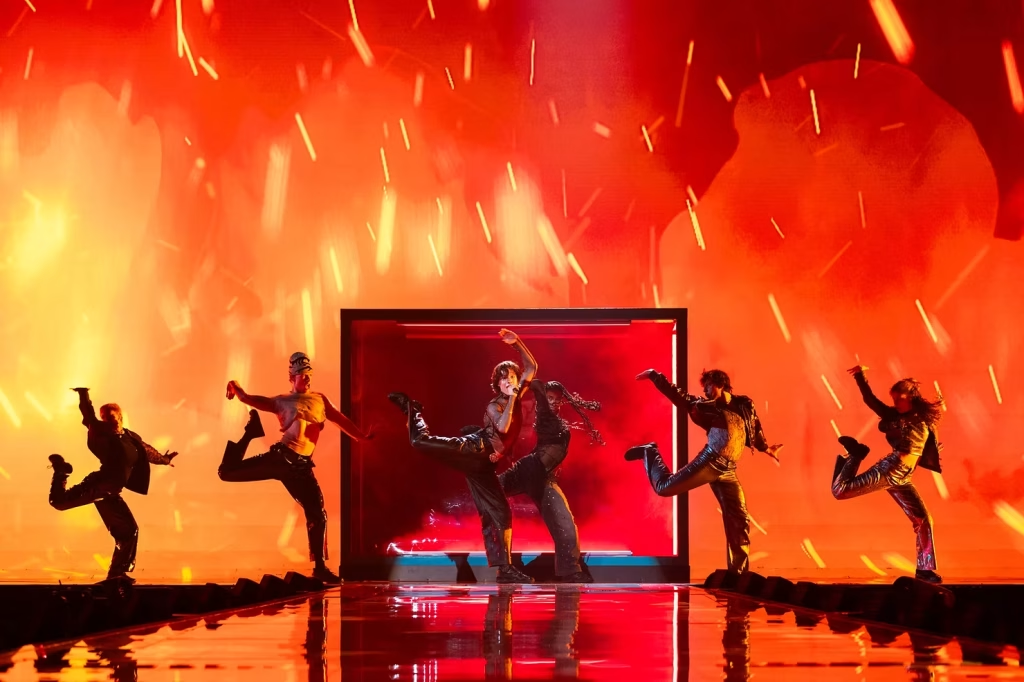
It opens with restraint. Just Søren, blue lighting, and a close-up shot — an opportunity for the voice to shine amidst the introduction of subtle synths. And it’s immediately, unavoidably good. The dark eye makeup and colour story of the lighting set the tone before a single dancer appears. Then the box arrives.
A translucent box, five dancers inside — it’s almost as if it’s the physical embodiment of the song. The temptation and irresistibility of what lies on the other side of the wall draws Søren towards it. Søren enters the box upside down, microphone back in hand before you’ve even had time to process how smooth the transition was. It could have looked gimmicky. Instead, it’s polished storytelling with the artist diving head-first into desire.
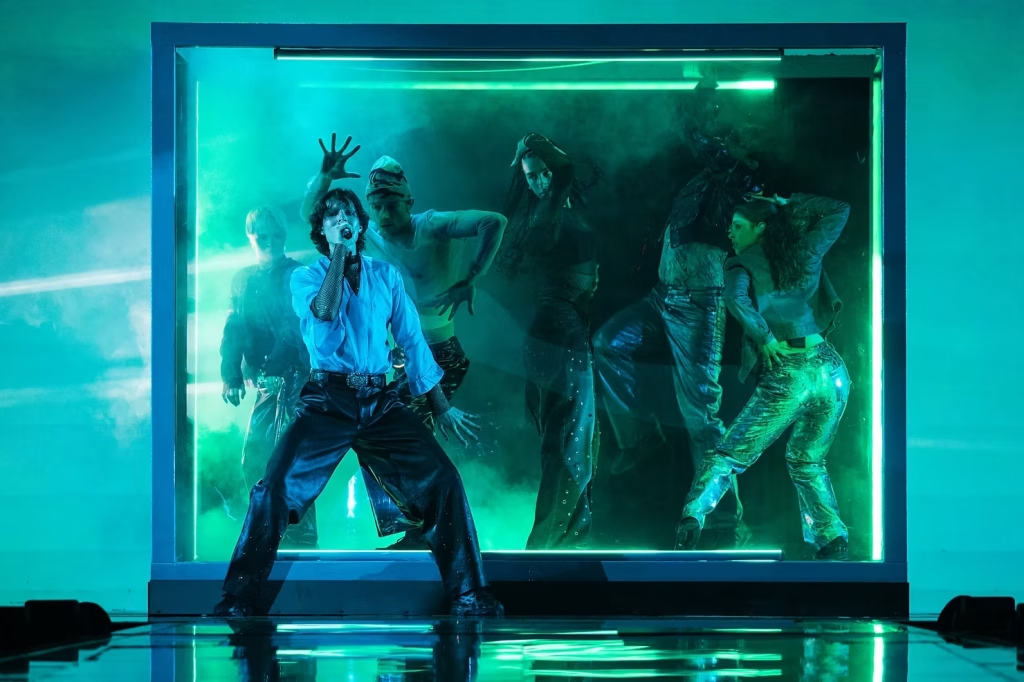
From there, the performance continues to build. The bass drops harder in the second chorus. The choreography sharpens inside the confined yet freeing space — the performers are working with the box rather than despite it. A mesh shirt reveal offers another memorable moment, helping Søren and the dancers transition out of the box. Then the high notes start, each one stronger than you expected. And just when you think it’s peaked — you hear the raw grit in the vocal. At this point, you can’t help but root for Søren who is clearly nailing every aspect of the performance. By the final section it’s unrelenting energy and choreography, and Søren never misses a step or note.
So — Could Denmark Actually Do It?
Juries are going to love the technical proficiency, the modern sonic quality, the cohesive and well-crafted staging concept, and the incredibly talented artist who owns the stage rather than survives it. For televoters, it’s about moments of connection and awe — and this performance has several standout examples. The eye contact, the entrance into the box, the choreography, the stunning vocals, the raw grit. You catch yourself entranced and reacting aloud in real time, which is exactly what you need in a crowded semi-final.
Før vi går hjem commits itself to a specific emotional world and performs it with total conviction. It offers Danish language, a queer narrative, a dark, club atmosphere, and theatrical staging — and it’s unmistakably Søren. With recent winners being intrinsically connected in a deeper sense to their songs and performances, this bodes well for Denmark’s chances especially with the juries.
Oh, and one more thing. Denmark won Eurovision in 2000. They didn’t win again until thirteen years later. If this pattern repeats itself, Før vi går hjem will be this year’s victor. Does this mean anything? No. But Eurovision runs on narrative, and I wouldn’t be surprised if a few commentators make mention of this.
Denmark finally looks like it knows who it is again. Right now, that’s Søren Torpegaard Lund — in and out of a translucent box, delivering one of the best performances of this year’s contest. Søren called the song “one long movement. A night that never stops.” Watch the performance once and you’ll understand exactly what he means.
Denmark performs 10th in the running order in Semifinal 2 on 14 May in Vienna.